

Semi-Precious Gemstones: The Hidden Gems
A guide to what else is out there other than Rubies, Sapphires and Emeralds...
A few of our Semi-Precious Wonders
Check out more of our portfolio here.
When we think of gemstones, the first thing that might come into our heads are Diamonds, Rubies, Sapphires and Emeralds. However, beyond The Big 4, there lies a whole host of mineral crystals which can be used to make fine jewellery.
Today, we look at a couple of our semi-precious gemstones and discuss the history, value and cultural significance of each.
If you're interested in checking out these pieces in real life, scroll below to book an appointment with us.
Also Check Out
Choosing a Diamond: The 4 Cs
Our Guide to Rubies
Our Guide to Sapphires
Click to check out our full Morganite Collection

Part of the same family as Emeralds from the Beryl family, Morganite shows a range of pink colours to portray a feminine and romantic look.
It was first discovered in Madagascar by George Kunz in the 1900s, a time where many new gems were being discovered in newly-opened mines funded by private individuals. One of these was JP Morgan himself, who had an affinity for gemstones. As a result, Kunz named the pink beryl Morganite, after JP Morgan. Check out more on its history here.
Morganite typically has a pale colour, but the more saturated the hue the more valuable it generally becomes. Increasingly, Morganite has been invading the jewellery fashion scene, where it is seen best to complement rose gold or diamonds. This gives the jewellery piece a modern approach to expressing romance. Check out more of our Morganite collection here.
Click to check out our full Tourmaline Collection

Rather than being a single variety of mineral, Tourmaline encompasses a big supergroup of minerals which have the same crystal structure but have different atoms within that structure. As a result, Tourmaline comes in a variety of colours, shades and hues.
Believed to have been originally discovered in the 1500s by the conquistadors in Brazil, they were initially confused for Emeralds as they were discovered. It was only until much later in the 1800s where gemologists realised that Tourmaline was its own species of mineral. To learn more about the history of this gem, click here.
Tourmaline is the most diverse coloured gemstone in the world, coming in shades ranging from green, red, blue and even the ability to be tri-coloured. However, the rarest of them all has got to be the Paraiba Tourmaline, as seen in the picture above. Paraiba Tourmaline is formed from a mixture between Boron and Copper in the crystal, leading to the highly coveted blue and green saturation in the crystal.
The biggest indicator of a Tourmaline's value is ultimately the colour and clarity, with the unique vivid blue Paraiba's coming in on top, and the crystals with the least tube-like inclusions being more valuable than the rest. Nevertheless, as with any piece of jewellery, the most important thing is to find the right piece for your style. If you would like to check out more of our Tourmaline's, check out our Tourmaline portfolio here.
Click to check out our full Turquoise Collection
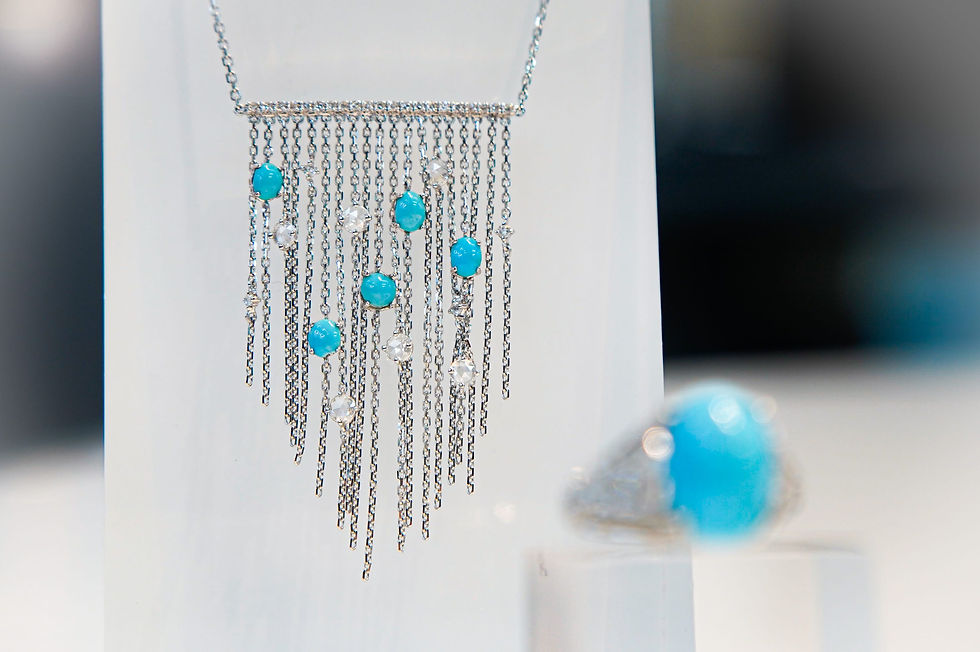
Since Ancient Egypt, Turquoise has been admired by people around the world for its unique and distinct colour. Known for being fashioned into jewellery by global societies, from the Egyptians, Native Americans and Turkish Traders along the silk road, Turquoise has held historical significance throughout ancient and modern society. Learn more about the history of this stone here.
So what makes Turquoise valuable? Most notably, you would be looking at its colour and the presence or absence of a matrix. Turquoise colours range from an intense blue to lime greens, with pure, saturated blues (known as Persian Blue) being the most desirable. Turquoise may also come with a matrix, or veins, which some consumers find desirable indicating natural beauty in its imperfection. However, others may see the veins as inclusions, and as such Turquoise without veins are typically seen as more valuable.
Ultimately, choosing a Turquoise, as with any stone, is subject to your personal preferences. Typically, Turquoise is paired with a white precious metal such as silver, or in Dynasty's case, 18k White Gold, due to exceptional colour match between robin-egg blue and white. Yet, many jewellers (us included) have also matched Turquoise with Yellow Gold, as was the case historically. To check out our Turquoise collection and see which metal with Turquoise suits you best, click here.
Click to check out our full Aquamarine Collection

Another member of the Beryl family, Aquamarine is named after the colour of seawater and has captivated us since the Roman era. As can be derived from its namesake, Aquamarine has long been associated with the sea. In fact, it has even been said that Aquamarine stones have been thrown by sailors into the ocean as a favour to sea deities to protect themselves from the perilous sea conditions.
Much later during the middle ages, Aquamarine was considered to protect its wearer from poisoning, leading to a large influx of rulers decided to wear aquamarine jewellery. The tradition of rulers wearing Aquamarine has even been kept up until today, where Prince Harry has gifted Meghan Markle an Aquamarine cocktail ring from the late Princess Diana's collection or the late Queen Elizabeth II's Aquamarine set including a tiara, earrings and a necklace.

Aquamarine is prized for its radiant blue and blue-green hue, mirroring the colour of seawater. Most notably, a deep, intense and rich colour, along with a larger sized crystal would tend to increase the value of the stone. However, do watch out for heat treatments, which artificially intensify the hue.
Aquamarine is not a particularly rare stone, most notably being found in deposits in Brazil, the Ural Mountains, Kenya or Madagascar. While Aquamarine can be found in deposits all over the world, the finest of them, the Santa Maria Aquamarine, is known for their intense blue hue. While originating from the Santa Maria de Itabira Mine in Brazil, such stones nowadays are mined all over the world.
Semi-precious gemstones are the future. While there is always a place for the Big 4 within the jewellery landscape, increasingly more and more consumers have drifted towards semi-precious stones. If you're interested in checking out our collection, check out our portfolio or book an appointment with us so that we can take you through the world of semi-precious stones.
